
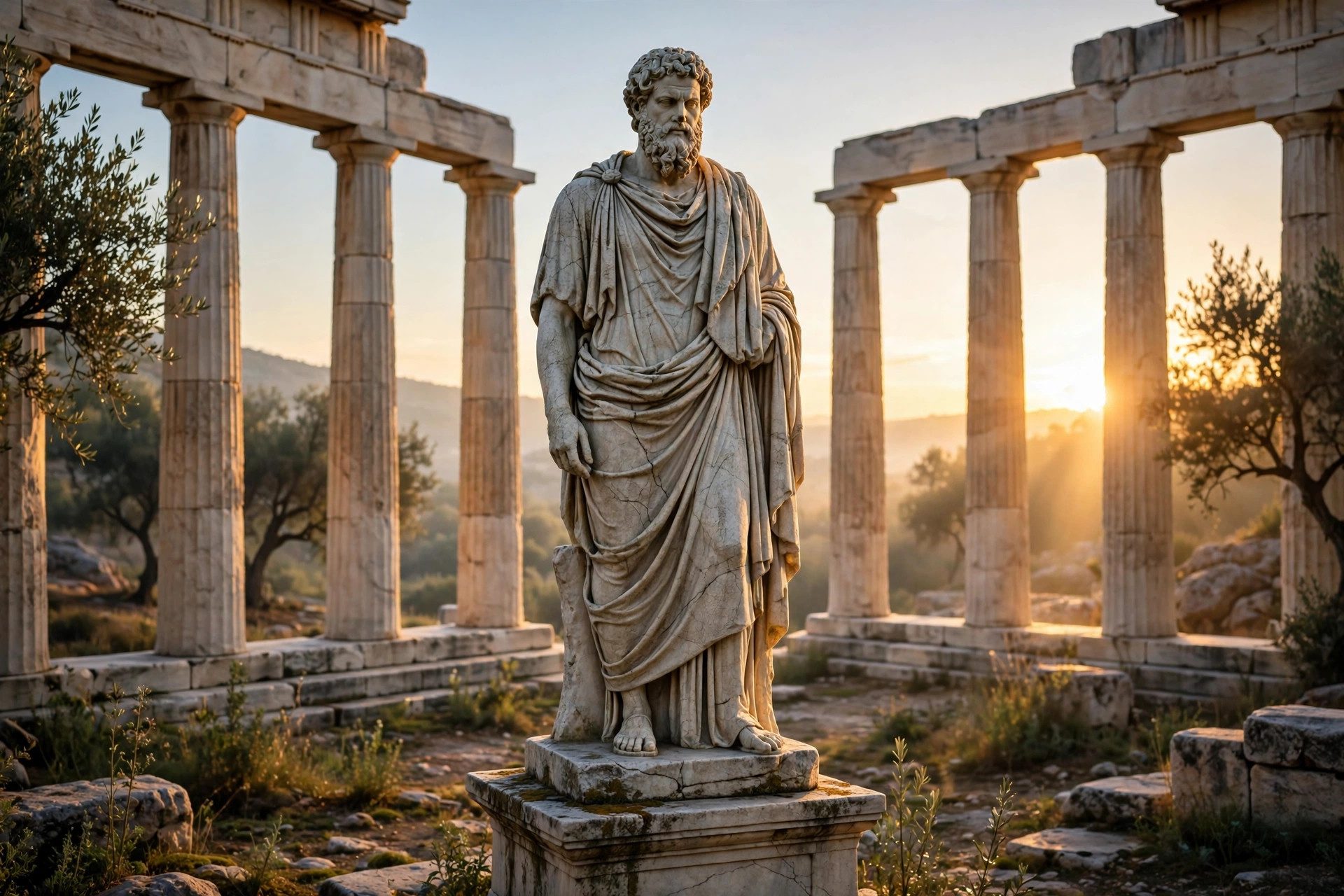
Stoicism is one of the most practical philosophies ever developed. Founded in Athens around 300 BCE, it offers a framework for handling stress, disappointment, and uncertainty — problems as relevant today as they were two thousand years ago. Unlike abstract philosophical systems, Stoicism was always meant to be lived: a daily practice for building resilience and inner calm.
This guide explains what Stoicism teaches, who its key thinkers were, and how you can apply its principles to modern life — from work stress to difficult relationships.
What Is Stoicism?
Stoicism is a school of Hellenistic philosophy founded by Zeno of Citium in Athens. It teaches that virtue — meaning wisdom, courage, justice, and temperance — is the only true good, and that external events are neither good nor bad in themselves. What matters is our judgment about them and how we respond.
The central Stoic insight is the dichotomy of control: some things are up to us (our judgments, intentions, and actions) and some things are not (everything else — other people's opinions, the weather, the past, the future). Suffering, the Stoics argued, comes from confusing the two: trying to control what we cannot, and neglecting what we can.
The Three Disciplines of Stoicism
The Roman emperor and Stoic philosopher Marcus Aurelius organized Stoic practice into three disciplines, drawn from the teachings of Epictetus:
1. The Discipline of Desire
Train yourself to want only what is within your control. Instead of craving wealth, fame, or other people's approval — things that depend on luck and others — focus your desires on your own character and choices. This does not mean abandoning ambition; it means detaching your happiness from outcomes you cannot guarantee.
2. The Discipline of Action
Act justly and for the common good. Stoics believed humans are social creatures, and that we flourish by contributing to our communities. The discipline of action asks: does this choice serve others as well as myself? It is the basis of Stoic ethics in daily life.
3. The Discipline of Assent
Examine your impressions before accepting them. When something happens — a rude email, a traffic jam, bad news — you experience an initial impression. The Stoic practice is to pause and ask: is my judgment about this accurate, or am I adding unnecessary suffering? This is essentially an ancient form of cognitive reframing, remarkably similar to techniques used in modern cognitive behavioral therapy.
Key Stoic Thinkers
Stoicism spans several centuries and three main phases. A few figures stand out:
- Zeno of Citium (334–262 BCE) — the founder, who taught in the Stoa Poikile (Painted Porch) in Athens, which gave the school its name.
- Epictetus (c. 50–135 CE) — a formerly enslaved man whose lectures, recorded by his student Arrian, became the Enchiridion (Handbook), the most concise statement of Stoic practice.
- Seneca (c. 4 BCE–65 CE) — a Roman statesman whose letters and essays explore Stoicism applied to wealth, grief, anger, and the shortness of life.
- Marcus Aurelius (121–180 CE) — Roman emperor whose private journal, the Meditations, is a record of a powerful man reminding himself to stay humble, patient, and just.
Core Stoic Principles for Modern Life
Memento Mori: Remember You Will Die
Stoics regularly contemplated mortality — not morbidly, but as a clarifying tool. Remembering that life is finite sharpens priorities: petty grievances shrink, and what truly matters comes into focus. Seneca wrote that we do not have a short life, but that we waste much of it.
Amor Fati: Love Your Fate
Beyond merely accepting what happens, the Stoics advocated embracing it. Obstacles, in this view, are raw material for growth. Marcus Aurelius wrote: "The impediment to action advances action. What stands in the way becomes the way." A setback at work or a personal disappointment becomes an opportunity to practice patience, creativity, or courage.
Premeditatio Malorum: The Premeditation of Adversity
Stoics practiced visualizing worst-case scenarios in advance — losing a job, facing illness, experiencing rejection. The point was not pessimism but preparation: by rehearsing adversity mentally, you rob it of its power to shock you, and you often discover it is more bearable than feared.
Sympatheia: The Interconnectedness of All Things
Stoics viewed the universe as a single living organism and humans as parts of a greater whole. This cosmopolitan outlook — Marcus Aurelius called himself "a citizen of the world" — grounds Stoic ethics: harming others is harming yourself, and service to others is service to the whole.
Common Misconceptions About Stoicism
Modern usage has distorted the term. Being "stoic" in casual speech means suppressing emotion, but actual Stoicism is not about feeling nothing. The Stoics distinguished between involuntary emotional reactions (which are natural) and the judgments we add to them (which are optional). The goal is not numbness but freedom from being ruled by destructive passions like rage, envy, and chronic anxiety.
Similarly, Stoicism is sometimes caricatured as passive resignation. In fact, it demands vigorous action where action is possible — it only counsels acceptance toward what genuinely cannot be changed. A Stoic does not shrug at injustice; a Stoic works to fix what can be fixed and stops tormenting themselves over the rest.
How to Practice Stoicism Daily
You do not need to read ancient Greek to benefit from Stoicism. Here are five exercises drawn directly from Stoic texts:
- Morning reflection: Marcus Aurelius began each day by previewing the difficulties ahead — difficult people, frustrating tasks — and resolving to meet them with patience.
- Evening review: Seneca recommended examining your day each night: What did I do well? Where did I fail my principles? What can I improve tomorrow?
- The view from above: Imagine looking down on your life from high above — your city, your country, the planet. Problems that feel enormous shrink to their true size.
- Voluntary discomfort: Occasionally skip a meal, take a cold shower, or sleep without a pillow. Small, chosen hardships build confidence that you can handle real ones.
- Journaling: Write out your impressions and examine them, as Marcus Aurelius did. The act of writing forces clarity about what you actually control.
Stoicism and Modern Psychology
Stoicism's influence extends well beyond philosophy. Cognitive behavioral therapy (CBT), one of the most evidence-backed psychological treatments, was directly inspired by Stoic ideas — particularly the claim that our emotional suffering comes from our judgments rather than events themselves. The founders of CBT, including Albert Ellis and Aaron Beck, acknowledged this debt explicitly.
Stoic ideas also appear in modern resilience training, sports psychology, and leadership literature. The U.S. military has even incorporated Stoic-inspired exercises into programs designed to build psychological resilience in soldiers.
Where to Start Reading
If Stoicism interests you, start with the primary sources — they are short and remarkably readable in modern translations:
- Meditations by Marcus Aurelius (the Gregory Hays translation is widely praised for clarity)
- Letters to a Friend by Seneca (practical essays on everyday problems)
- The Enchiridion by Epictetus (a compact handbook of Stoic exercises)
For a modern introduction, A Guide to the Good Life by William B. Irvine explains Stoic techniques in contemporary language. Whether you adopt Stoicism as a full philosophy or borrow a few of its tools, its central lesson remains powerful: you cannot control the world, but you can always control your response to it — and that is enough. Explore more ideas in our philosophy collection, including our explainer on the trolley problem.