
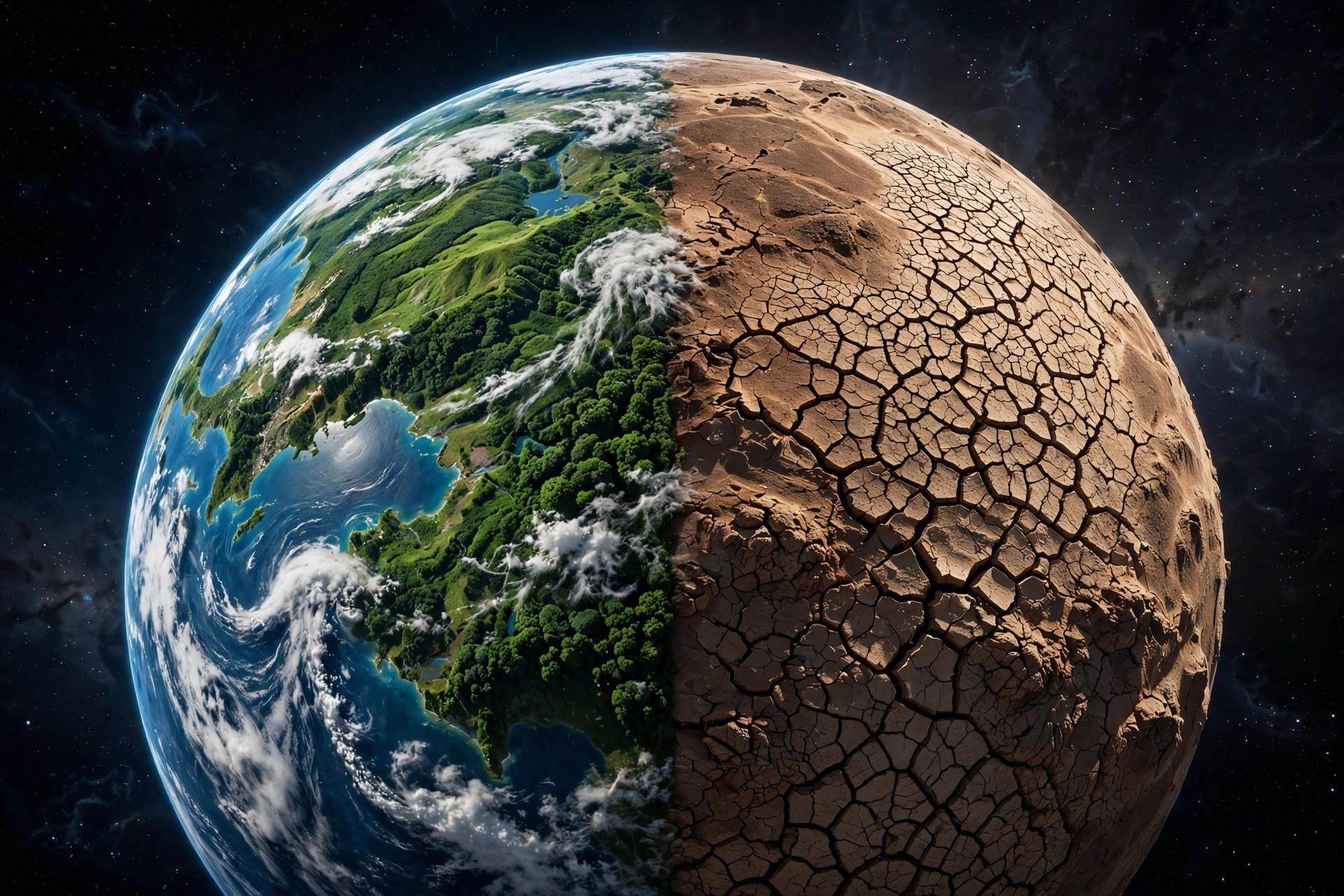
Climate change is one of the most consequential issues of our century — and one of the most discussed. But the phrase covers a lot of science, and it is easy to lose track of what it actually means. This guide explains the essentials: what climate change is, how scientists know it is happening, what causes it, and what can be done about it.
Climate vs weather: an important distinction
Weather is what happens day to day — rain, sunshine, a cold snap. Climate is the long-term pattern: the average weather of a region over decades, including typical temperatures, rainfall, and seasons. Climate change means those long-term patterns are shifting. A cold winter day does not disprove global warming, just as a hot day does not prove it — what matters is the decades-long trend.
The greenhouse effect, step by step
Certain gases in the atmosphere — notably carbon dioxide, methane, and nitrous oxide — trap heat radiating from Earth’s surface. This natural greenhouse effect keeps the planet warm enough for life; without it, Earth would be frozen. Here is how it works:
- Sunlight passes through the atmosphere and warms Earth’s surface.
- The surface radiates that energy back upward as heat (infrared radiation).
- Greenhouse gases absorb some of this outgoing heat and re-radiate it in all directions — including back down toward the surface.
- The result: the lower atmosphere stays warmer than it otherwise would.
Human activities have increased the concentration of these gases, strengthening the effect and warming the planet beyond its natural balance. Think of it as thickening a blanket that was already keeping us warm.
The main greenhouse gases and where they come from
| Gas | Main human sources | Notes |
|---|---|---|
| Carbon dioxide (CO₂) | Burning fossil fuels (coal, oil, gas), deforestation | The biggest driver; stays in the atmosphere for centuries |
| Methane (CH₄) | Agriculture (especially livestock), landfills, fossil-fuel leaks | Much more potent per molecule than CO₂, but shorter-lived |
| Nitrous oxide (N₂O) | Fertilizers, some industrial processes | Long-lived and potent |
Carbon dioxide gets the most attention because humans emit it in the largest quantities and it persists so long — today’s emissions will still be warming the planet centuries from now.
Natural vs human-caused change
Earth’s climate has changed naturally over geological time — ice ages came and went long before humans existed, driven by volcanic activity, shifts in Earth’s orbit, and changes in solar output. Scientists know about these natural drivers and account for them. What makes the current warming different is its speed and its fingerprint: it is happening far faster than natural cycles, it coincides exactly with industrial emissions, and the chemical signature of the extra CO₂ matches fossil fuels, not volcanoes or other natural sources. Natural factors alone cannot explain the observed warming; human activities can.
The evidence scientists cite
Multiple independent lines of evidence point to human-driven warming: thermometers show rising global surface temperatures; satellites and ocean sensors show warming oceans and shrinking ice; tide gauges show rising sea levels; and the chemical fingerprint of the extra carbon dioxide matches fossil-fuel combustion. Major scientific assessments, such as those of the IPCC (the Intergovernmental Panel on Climate Change — the UN body that synthesizes thousands of peer-reviewed studies), confirm these trends with high confidence.
Observed and projected impacts
Documented changes include more frequent and intense heatwaves, heavier precipitation events in many regions, longer droughts in others, ocean acidification as seas absorb carbon dioxide, and shifts in ecosystems and growing seasons. Future impacts depend on how quickly emissions fall — which is why international agreements and national policies focus on emission reductions. Low-lying coastal areas face particular risks from sea-level rise, while agriculture must adapt to shifting rainfall and temperature patterns.
Key terms worth knowing
- Carbon footprint: the total greenhouse-gas emissions caused by a person, product, or activity. See our guide on how to reduce your carbon footprint.
- Net zero: balancing emissions produced with emissions removed, so the net addition to the atmosphere is zero. Many countries and companies have set net-zero target dates.
- Tipping points: thresholds beyond which changes become self-reinforcing — such as the collapse of major ice sheets — making them effectively irreversible on human timescales.
- Mitigation vs adaptation: reducing emissions (mitigation) versus adjusting to the changes already underway (adaptation).
Mitigation and adaptation
Responses fall into two categories. Mitigation means reducing greenhouse-gas emissions — for example, shifting to renewable energy like complete guide to climate change causes, effects and solutions.k">solar power, improving energy efficiency, electrifying transport (see electric vs gasoline cars), and protecting forests. Adaptation means adjusting to changes already underway, such as redesigning infrastructure for extreme weather, developing heat-resilient crops, or managing water supplies differently.
Both are necessary: mitigation determines how much warming ultimately occurs, while adaptation protects people from the warming that is already locked in.
International efforts: from Kyoto to Paris
Climate change is a global problem — emissions from anywhere warm everywhere — so countries have tried to coordinate. The 1997 Kyoto Protocol set binding targets for developed nations, with mixed results. Its successor, the 2015 Paris Agreement, took a different approach: nearly every country pledged its own emission-reduction targets (called nationally determined contributions) with the shared goal of holding warming well below 2°C above pre-industrial levels, aiming for 1.5°C.
Progress is tracked through regular global summits (the annual COP conferences) and scientific stocktakes. Pledges have strengthened over time, but a persistent gap remains between what countries have promised and what the science says is needed — which is why each round of negotiations matters. Understanding these agreements helps make sense of climate headlines: when you read about a new national target or a COP outcome, you are reading about attempts to close that gap.
What individuals and communities can do
Systemic change — energy policy, industry standards, international agreements — does most of the heavy lifting. But individual and community actions still matter: reducing energy waste at home, choosing efficient transport, cutting food waste, and recycling properly all reduce emissions. Perhaps most importantly, informed citizens can support and demand stronger climate policies. Collective action starts with understanding the problem — which is exactly what this guide is for.