
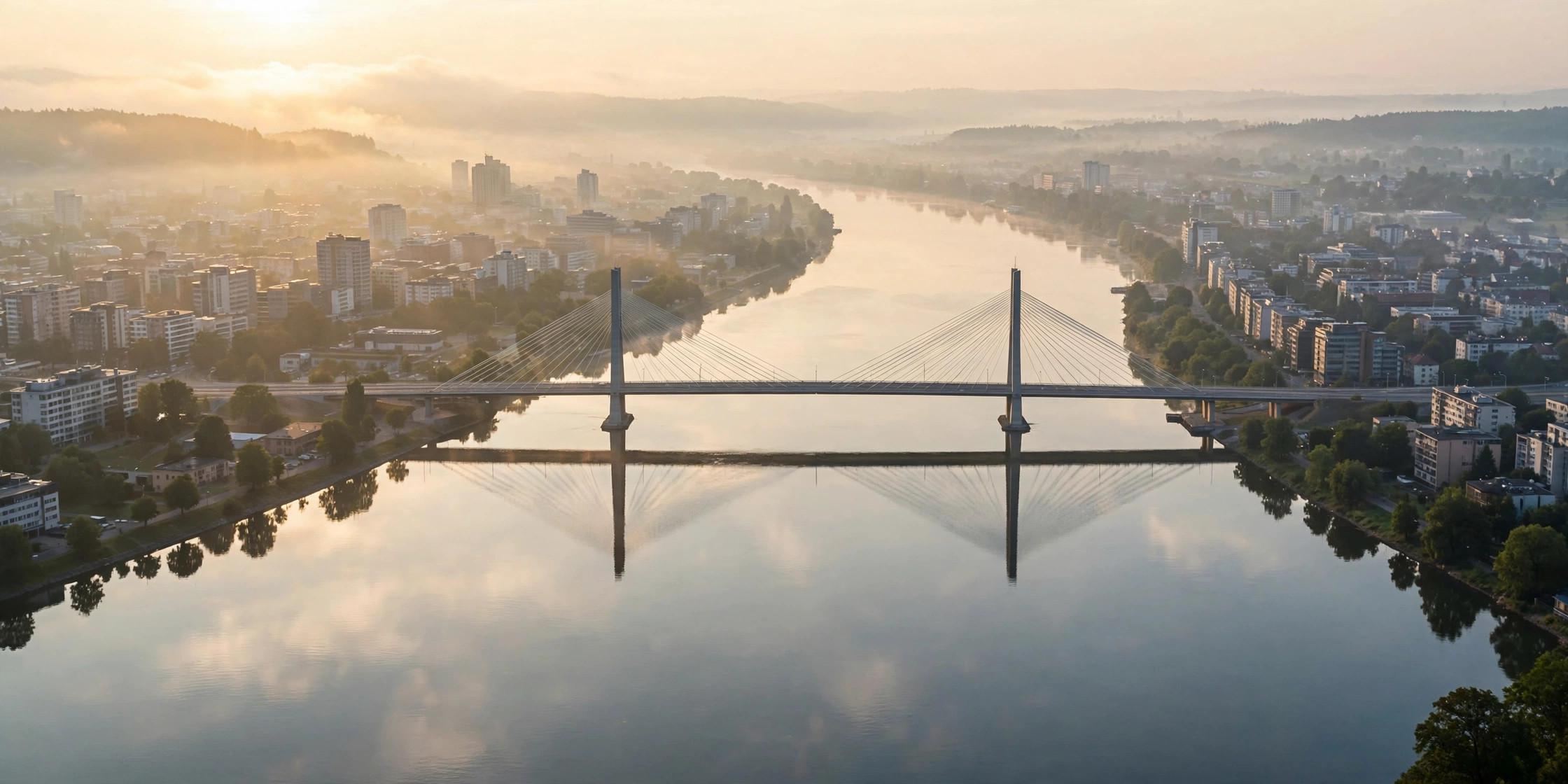
After sitting finished but unused for twelve years, one of Asia’s most geopolitically significant bridges is finally opening. China’s state-run Xinhua News Agency announced on Wednesday, 14 October 2026, that the New Yalu River Bridge linking Dandong in China’s Liaoning province with Sinuiju in North Korea will officially open on 15 October, with the two countries holding a joint opening ceremony on the day. The story is trending per news coverage across Reuters, Xinhua, the Seoul Economic Daily, and syndicated outlets around the world.
The announcement ends one of the longest-running oddities in Northeast Asian infrastructure: a gleaming, fully built, four-lane international bridge that has carried no traffic at all since its main structure was completed in 2014. For more than a decade it stood as a monument to a relationship that had gone cold — and its opening is now being read as one of the clearest physical signs yet that Beijing and Pyongyang are warming up again.
What exactly is opening
The New Yalu River Bridge is a cable-stayed road bridge spanning the Yalu River, the waterway that forms much of the border between China and North Korea. It connects Dandong New District (Langtou) in Liaoning province with Sinuiju, the capital of North Korea’s North Pyongan province and one of the country’s most important border cities.
The crossing measures roughly 3,030 metres — about three kilometres — and carries four lanes of traffic in both directions. It sits about 13 kilometres southwest of the existing China–North Korea Friendship Bridge, the older crossing between Dandong and Sinuiju that has long handled most road and rail traffic between the two countries. The new bridge was designed to relieve that bottleneck and to give the border region a modern, high-capacity road crossing suited to a much larger volume of trade.
China funded the entire project, paying roughly 2.2 billion yuan for construction. The Chinese side, including its customs and inspection facilities, was finished on schedule. What was missing for twelve years was the other end: the connecting roads and customs facilities on the North Korean side.
Why the bridge waited twelve years
The project was launched in 2009, when relations between Beijing and Pyongyang were friendly, and construction began in December 2010. The main bridge structure and the Chinese-side facilities were completed by October 2014. By any normal measure, the crossing should have opened then.
Instead, it sat idle. North Korea never finished its approach roads or its customs facilities, and the reasons were political rather than technical. After Pyongyang carried out a series of nuclear tests, China joined United Nations sanctions on North Korea, and relations between the two neighbours cooled sharply. A bridge built to carry a surge in cross-border trade had little purpose while sanctions and strained ties kept that trade constrained.
The delay became something of a symbol. Satellite images over the years showed the completed bridge ending abruptly at the North Korean bank, with no road network to receive it. Analysts cited it as a case study in how geopolitics can strand even finished infrastructure — a bridge to nowhere created not by bad planning, but by a diplomatic freeze.
Why now: a diplomatic thaw
The mood began to shift in September last year, when North Korean leader Kim Jong-un visited China, restoring high-level dialogue between the two countries. Analysts say a visit by Chinese President Xi Jinping to Pyongyang in June of this year gave particularly strong impetus to preparations for the opening.
There were signs an opening was imminent before the official announcement. There had been expectations that the bridge would open on 6 October, the 77th anniversary of diplomatic relations between China and North Korea, but no event was held that day. Then, on 13 October, North Korea’s national flag and China’s five-starred red flag were raised at the North Korean entrance to the bridge — a visible signal that the crossing was about to come into use.
The opening also follows another notable first: weeks earlier, North Korea opened its first road bridge with Russia, a separate crossing that similarly signalled Pyongyang’s effort to strengthen its land connections with its two most important neighbours. Taken together, the two openings suggest a deliberate push by North Korea to improve its physical links to the outside world after years of pandemic-era isolation and sanctions pressure.
Why the bridge matters
The immediate significance is economic. Dandong and Sinuiju have long been the most important gateway for trade between China and North Korea, and a modern four-lane crossing substantially increases the capacity of that gateway. China’s exports to North Korea rose to a six-year high of $2.3 billion last year, a 25% increase over the previous year, according to figures cited by Reuters — still well short of the levels seen before UN sanctions were imposed in 2017, but a sign that commercial activity is recovering.
For North Korea, the bridge offers a more efficient route for the goods it imports and for any expansion of cross-border commerce. For China, it strengthens the infrastructure of its northeastern border region and deepens economic ties with a neighbour whose stability Beijing has long treated as a strategic priority.
The diplomatic significance may be larger still. Infrastructure openings of this kind are rarely just about concrete and steel. The joint opening ceremony, the flags, and the timing all send a message: that the two countries are publicly demonstrating the repair of a relationship that spent years under strain. In a region shaped by the US–China rivalry, North Korea’s weapons programmes, and shifting alliances, a bridge can be a statement.
That is also why the opening will be watched closely beyond Beijing and Pyongyang. South Korea, Japan, and the United States all follow North Korea’s external relationships for clues about its intentions. Recent months have already seen heightened tension on the Korean Peninsula, including North Korean missile launches toward the East Sea and continued pressure on Pyongyang’s illicit revenue streams, such as the North Korean “laptop farm” scheme targeted by US prosecutors. Against that backdrop, a bridge opening is a reminder that North Korea’s diplomacy is not only about missiles — it is also about roads, trade, and neighbours.
Sanctions questions to watch
One question analysts will be asking is whether the new crossing complicates the enforcement of UN sanctions on North Korea. Opening a bridge is not itself a sanctions violation, and China has said its trade with North Korea complies with its international obligations. But sanctions restrict the transfer of certain goods and materials to North Korea, and a high-capacity new crossing inevitably raises questions about what will travel across it and how carefully cargo will be inspected.
The practical answer will emerge over the coming months, as the volume and type of traffic on the bridge become visible. Trade data, satellite imagery of truck movements, and statements from governments in the region will all help show whether the bridge mainly serves ordinary commerce — food, consumer goods, construction materials — or whether it becomes a new pressure point in the long-running dispute over sanctions enforcement.
A related question is tourism and people-to-people exchange. Border crossings can also carry visitors, workers, and officials, and a modern crossing makes all of that easier. Any increase in movement across the border would be a further sign of North Korea’s gradual reopening after the pandemic-era border closure, which for years sealed the country off almost entirely.
What to watch next
The first test will be the opening ceremony itself on 15 October: who attends, what is said, and what the imagery shows. High-level attendance would underline the political weight both sides attach to the crossing. The first weeks of traffic — how many trucks, in which direction, carrying what — will matter more than the ceremony.
Beyond that, the bridge is worth watching as one piece of a larger pattern. North Korea’s relations with both China and Russia have been warming, its trade is recovering from pandemic-era lows, and its border infrastructure is being modernised. None of that resolves the central security questions on the Korean Peninsula, but it does suggest that Pyongyang is investing in its connections to the world rather than retreating from them.
It also offers a useful reminder about the long arc of infrastructure. The New Yalu River Bridge was conceived in a friendlier era, completed during a freeze, and opened in a thaw — twelve years late, but perhaps arriving at exactly the moment its builders’ geopolitical logic makes sense again. Bridges, unlike summits, do not expire. This one waited out the politics, and the politics eventually came back to it.
Sources
Reporting drawn from Reuters (14 October 2026), Xinhua News Agency via Reuters, the Seoul Economic Daily, and syndicated coverage of the announcement.