
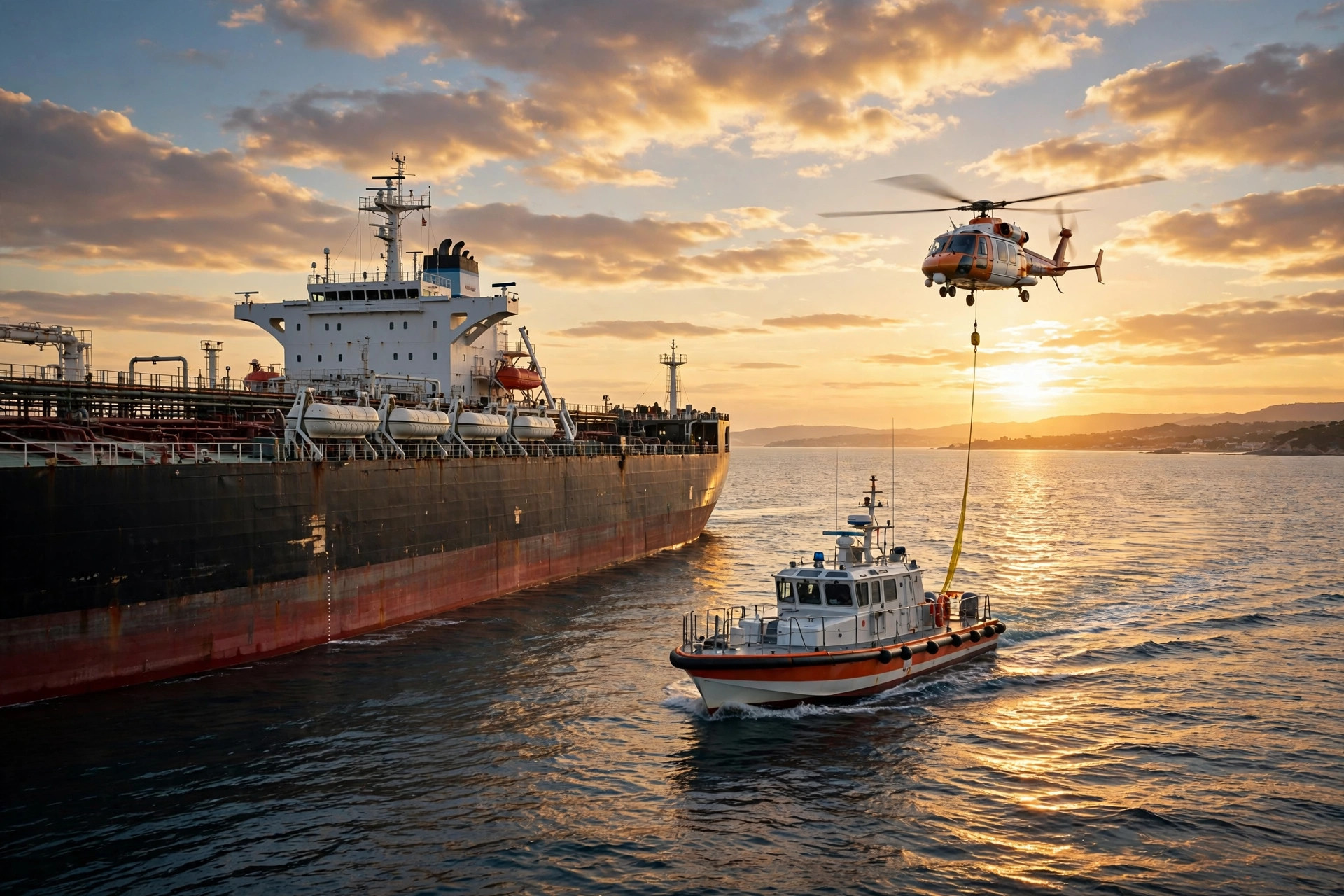
Around 10 October 2026, the United Arab Emirates national guard rescued 22 crew members from a burning oil tanker in the Persian Gulf, pulling the sailors to safety, giving them first aid, and reporting them to be in stable condition. The rescue is one more flashpoint in a waterway that has become the focal point of a widening regional confrontation — with attacks on commercial vessels surging, conflicting reports emerging about naval mines, and a major Gulf airport struck by a missile on the same day. For anyone who depends on affordable fuel, stable shipping, or calm markets, what is happening around the Strait of Hormuz is worth understanding in detail.
This explainer sets out what is known about the rescue, the separate and unverified reports circulating around it, the background of the ongoing US-Iran conflict, and why this narrow strip of water between the Persian Gulf and the open ocean matters so much to the global economy.
Why the Strait of Hormuz matters so much
The Strait of Hormuz is a narrow waterway between Iran to the north and Oman and the UAE to the south, linking the Persian Gulf to the Gulf of Oman and onward to the Arabian Sea and the wider Indian Ocean. It is one of the world's most important maritime chokepoints: a huge share of the oil and liquefied natural gas produced by Gulf states must pass through it to reach markets in Asia, Europe, and beyond. There is no practical alternative route of comparable capacity for much of this crude oil, which is why any disruption in the strait tends to register almost immediately in global energy markets.
Geography makes the strait unusually vulnerable. At its narrowest points it is only a few dozen kilometres wide, and the traffic lanes used by large tankers run close to territorial waters, meaning vessels can be shadowed, boarded, or harassed with relative ease. For decades, the strait has been a pressure point whenever tensions between Iran and its rivals have risen: Tehran has periodically threatened to close it, mines have been laid in and around it in past conflicts, and commercial ships have been attacked or seized during earlier standoffs. It is also why any reports of mines, attacks, or interference there are taken extremely seriously by governments, energy companies, and insurers.
The countries that depend on the strait include the biggest oil exporters in the world — Saudi Arabia, the UAE, Kuwait, Iraq, and Qatar — as well as major importers, especially in Asia, whose refineries and power grids depend on a steady flow of Gulf crude. When the flow is threatened, buyers look for alternative sources, freight rates move, and the cost of doing nothing — or of acting too slowly — climbs quickly for policymakers.
What happened: the UAE rescue
According to reports from around 10 October 2026, the UAE national guard carried out a rescue operation for 22 crew members of an oil tanker that was burning in the Persian Gulf. All 22 were reported to be of Asian nationalities. They were brought to safety, given first aid, and described as being in stable condition.
Several important details remain unspecified. The tanker itself was not identified by name, flag, or owner in the reports. The precise location of the incident within the Gulf was not specified, and no cause for the fire was given. That means the basic facts — a burning tanker, 22 rescued crew, all stable — are established, while the question of what set the vessel alight remains open.
That absence of detail matters, because it leaves open more than one possible explanation for the fire. A fire on a large tanker can have many causes, from mechanical failures and engine-room incidents to cargo-related accidents. It can also result from an attack. Without an identified vessel, an official statement on the cause, or independent verification, it is not possible to say which of these applies. Readers should treat claims about the cause as unconfirmed until authorities or reliable investigators establish the facts.
A separate claim: the naval mine report
Separately, Iran's state news agency IRNA cited the navy of the Islamic Revolutionary Guard Corps as saying that a tanker was burning after hitting a naval mine while transiting the Strait of Hormuz. This is a distinct claim from a distinct source, and it is not clear whether it refers to the same incident as the UAE rescue operation.
This distinction is worth stating plainly: the rescue operation and the mine claim have been reported through different channels, with different details, and there is currently no confirmed link between them. It should not be assumed that the vessel the Revolutionary Guard navy referred to is the same one from which the UAE national guard rescued the 22 crew members.
If a naval mine did damage a commercial tanker in the strait, that would be a significant development on its own. Mines are a weapon with a long history in these waters — they were used in the Gulf during the Iran-Iraq war of the 1980s and have been found or suspected in later incidents. A confirmed mine strike on a commercial vessel in 2026 would signal a serious escalation in the ongoing confrontation and would almost certainly change how shipping companies, insurers, and navies assess the risk of transiting the strait.
The wider conflict: a surge of attacks in the strait
Whatever the cause of this particular fire, it is unfolding against a backdrop of rising attacks on commercial vessels in the Strait of Hormuz. This surge is tied to the ongoing US-Iran conflict, which began with joint US-Israeli strikes on Iran on 28 February 2026. Since then, the confrontation has widened across the region, with the strait — Tehran's most potent point of leverage over global energy — becoming a central arena.
Iran has strong incentives to assert control over the waterway. The strait is both a defensive perimeter and an offensive tool: by threatening, harassing, or disrupting commercial shipping there, Tehran can impose economic costs on its adversaries and their allies without launching a direct attack on a foreign military. This is a pattern familiar from past Gulf crises, where pressure on commercial shipping has served as a way to signal resolve, extract concessions, or retaliate for strikes.
For the United States and its partners, the priority is keeping the waterway open and commercial traffic moving. That effort can involve naval escorts, minesweeping, intelligence sharing, and coordination with Gulf states whose own ports and coastlines sit along the shipping lanes. The UAE's rescue operation is, on its face, a humanitarian act — sailors in danger were pulled from a burning ship — but it also illustrates how Gulf states are being drawn directly into the consequences of the confrontation in their own backyard.
Riyadh struck again: the conflict's other fronts
The same day as the tanker incident brought news from another front. King Khalid International Airport in Riyadh, Saudi Arabia, was struck again by a missile, with several people wounded. This was not the first strike on the airport, and the repeat attack underscores how the conflict has spread beyond the waterways to civilian infrastructure deep inside the region's largest economy. For background on the pattern of strikes hitting the Saudi capital, see our explainer on the Iran-Houthi-Saudi Riyadh attacks of October 2026.
Meanwhile, US President Trump said he was evaluating whether the United States should join Saudi strikes on the Iran-backed Houthis in Yemen. The Houthis, a Yemeni armed movement supported by Iran, have been a key regional ally of Tehran and have been involved in attacks on shipping and on Saudi and allied targets in the past. A decision by Washington to join Saudi operations against them would mark a further widening of the conflict — moving from the strait and the Gulf to the Arabian Peninsula's southern front.
In a sign of how quickly the aviation sector reacts to such escalation, Kuwait Airways canceled its flights to Riyadh. Airlines are among the most sensitive barometers of regional risk: they cancel routes fast when airports are struck or airspace becomes contested, and the resumption of normal schedules can take far longer than the disruption itself. The cancellation adds a practical, visible cost to the escalation for ordinary travelers and for the region's connectivity.
Why it matters: energy markets
Every incident in or near the Strait of Hormuz feeds into the same set of market calculations. Traders, refiners, and governments watch the strait because even a partial or temporary disruption can tighten the global oil supply and push prices higher. The mechanism is straightforward: if tankers cannot transit safely, less crude reaches buyers on schedule, inventories draw down, and the price of the remaining available barrels rises to ration demand. Because energy prices feed into transport, manufacturing, and food costs, a sustained disruption can add to inflation across many economies — a dynamic explained in our guide to what inflation is and how it works.
Markets do not wait for confirmation before reacting. Reports of a burning tanker, a mine strike, or a missile attack on an airport can move prices and freight rates within hours, even when the details are thin or conflicting. This creates an incentive for careful reading: the first reports of an incident are often the least reliable, and the distinction between a confirmed fact, an attributed claim, and a rumor matters a great deal when billions of dollars of cargo are at stake.
Governments with strategic petroleum reserves — stockpiles of crude oil held for emergencies — watch these developments closely, because a serious disruption in the strait is one of the scenarios those reserves exist for. Importing countries may also accelerate efforts to diversify suppliers or bring forward renewable and efficiency measures, though those shifts play out over years rather than days.
Why it matters: shipping insurance and the cost of trade
Beyond the price of oil itself, attacks and suspected attacks in the strait raise the cost of moving goods by sea. Marine insurers respond to heightened risk by increasing premiums for vessels transiting affected waters, sometimes dramatically, and by attaching new conditions or exclusions to coverage. These costs — sometimes called war-risk premiums — are ultimately paid by shipowners and charterers and passed through supply chains to importers and consumers.
Insurers also rely on the assessments of maritime security firms and naval authorities, and on the track record of actual incidents. A rescue from a burning tanker, a mine report, and a missile strike on an airport within the same news cycle all feed the same risk models. Even when individual incidents turn out to have innocent causes, the accumulation of reports can keep premiums elevated for months.
Shipowners make their own calculations too. Some may reroute vessels, slow down transits, hire armed security, or simply decline charters into the region — each choice carrying its own cost. At the extreme, a sustained campaign of attacks could reduce the number of tankers willing to call at Gulf ports, tightening the market for available tonnage and adding to freight costs on top of the insurance burden.
Key facts
What is confirmed: around 10 October 2026, the UAE national guard rescued 22 crew members from a burning oil tanker in the Persian Gulf; the crew, all of Asian nationalities, received first aid and were in stable condition; the tanker was not identified; the location and cause of the fire were not specified. What is claimed but separate: Iran's IRNA cited the Revolutionary Guard Corps navy as saying a tanker hit a naval mine in the Strait of Hormuz — it is unclear whether this is the same incident. The context: attacks on commercial vessels in the strait have surged during the ongoing US-Iran conflict that began with joint US-Israeli strikes on Iran on 28 February 2026, with Tehran seeking to assert control over the waterway. On the same day: a missile struck King Khalid International Airport in Riyadh again, wounding several; President Trump said he was evaluating US participation in Saudi strikes on the Iran-backed Houthis in Yemen; and Kuwait Airways canceled its Riyadh flights. Sources: Associated Press via Reflector, The National, Reuters, October 2026.
What happens next
The near-term trajectory depends on answers that are not yet available. If investigators identify the tanker and establish what caused the fire, that will settle the biggest open question of this incident. If the mine claim is independently verified — or debunked — it will tell governments and markets whether the threshold of mining commercial traffic in the strait has actually been crossed.
Several developments bear watching. First, whether attacks on commercial vessels in the strait continue, accelerate, or pause — the pattern over the coming weeks will determine whether this was an isolated cluster or a sustained campaign. Second, whether the United States decides to join Saudi strikes on the Houthis in Yemen, which would open a new front and could prompt retaliatory attacks on shipping or Gulf targets. Third, whether Tehran makes any explicit move regarding the strait itself, such as a formal threat to close it or further demonstrations of control. Fourth, how insurers and shipowners price the risk — sustained high premiums are themselves a signal that the industry expects more trouble.
Finally, the diplomatic track matters. Regional and international actors have strong interests in keeping the strait open and the conflict contained, and past Gulf crises have typically involved intense behind-the-scenes negotiation even while incidents continued in public view. Whether de-escalation efforts gain traction — and whether they can keep pace with events on the water — will shape how long this period of instability lasts.