
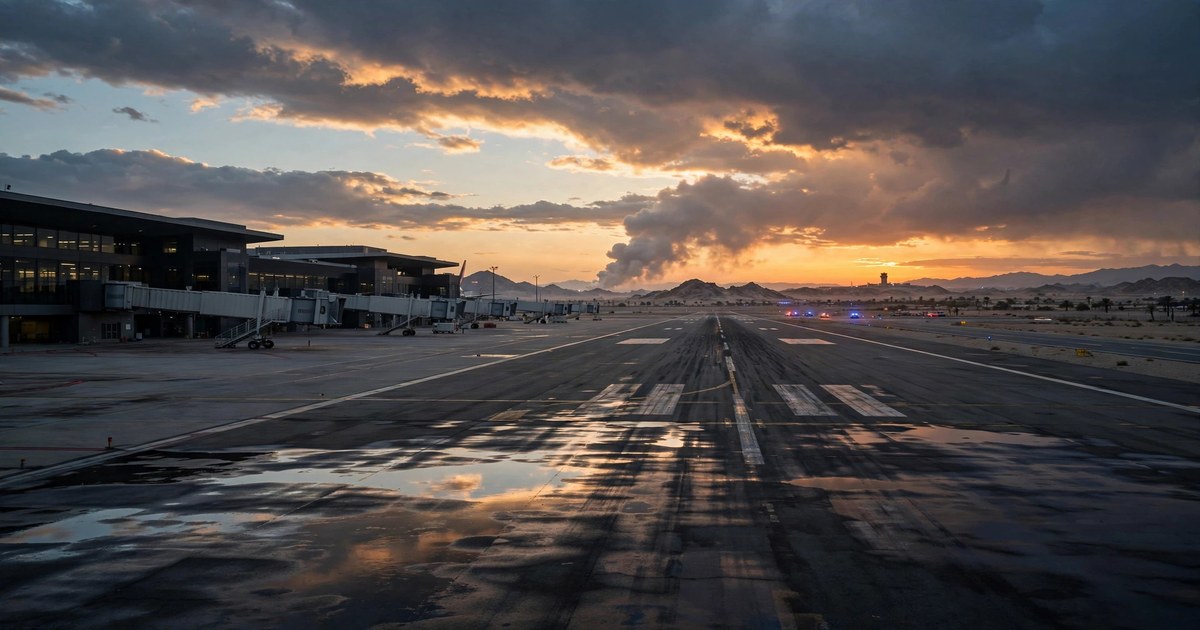
Saudi Arabia has shifted from absorbing blows to striking back. After a week of Houthi attacks that turned the kingdom's airports into targets — including the deadliest assault on Saudi territory in decades — Saudi state-run media reported on Monday that the kingdom's forces had responded to drone and cruise-missile attacks, while Houthi-run outlets said overnight airstrikes had pounded Yemen's capital, Sanaa. Riyadh's King Khalid International Airport, the country's second-busiest, remains closed with no announced reopening date, and a newly formed bloc of regional powers has lined up behind the kingdom.
The fast-moving developments mark a dangerous new phase in a conflict that has already killed roughly 20 people at Saudi airports in the past week and threatens to widen into a broader regional war, with the United States weighing whether to join the fight.
What happened on Monday
Saudi state media said on Monday that the kingdom's forces had responded to attacks involving drones and cruise missiles, though officials gave no details on what the response entailed. The report followed a weekend of extraordinary assaults: a deadly missile strike on Riyadh's airport on Saturday that killed at least 12 people and wounded more than 300, and another strike on Sunday that hit terminals three and four, killing one person — believed to be a Pakistani national — and injuring 11.
Hours later, the Houthi-run health ministry said airstrikes on two districts of Sanaa around midnight had killed one person and wounded 12 others. A ministry spokesman said a strike on a salt factory in the capital's Hamadan district killed a man and wounded eight people, while a separate strike on a house wounded a woman and three children. The rebels' media centre blamed Saudi Arabia for the strikes, which came as the Houthis continued firing missiles and drones toward Saudi airports. There was no immediate comment from Riyadh on the claims.
The Houthis also said Saudi warplanes had carried out 124 airstrikes across Yemen in the preceding 24 hours and vowed to keep targeting Saudi airports and infrastructure in response.
The air-defence question
One of the most significant Monday developments was Saudi Arabia's own reckoning with how the strikes got through. The kingdom opened an investigation into what officials described as an air-defence failure at King Khalid International Airport — one of the most secure areas in the country. According to two regional officials briefed on the probe, an initial assessment found the Houthis first launched swarms of drones to saturate and pave the way for a follow-up mix of cruise and ballistic missiles to reach the airport.
The finding raises uncomfortable questions about the effectiveness of the kingdom's Western-supplied air and missile defences, including possible gaps in detection, interception and coverage. It may also explain why the airport's closure has been extended indefinitely: Saudi Arabia's civil aviation authority declined on Monday to say when King Khalid would resume operations, a signal that officials do not yet trust the security situation.
Riyadh under pressure: offices empty, schools online
The impact is rippling through daily life in the capital. Businesses in Riyadh's King Abdullah Financial District — home to the Saudi sovereign wealth fund, an Aramco office, the stock exchange and global firms including Goldman Sachs — have told employees to work remotely, according to multiple employees who spoke on condition of anonymity. Authorities have also asked schools to switch to online classes this week following the deadly weekend strikes.
Governments are responding too. The Houthis' warning to airlines to avoid Saudi airports has been reinforced by official travel advisories: the United States, the United Kingdom, Spain and Canada are among countries warning citizens against using the airport. The US Federal Aviation Administration told American airlines on Sunday to exercise caution when flying to or over Saudi Arabia, citing threats to aircraft at all altitudes and interference with navigation systems. The British Foreign Office went further, suggesting its citizens consider departing Saudi Arabia overland to neighbouring countries — an extraordinary advisory for one of the world's wealthiest states.
The R4 bloc: Turkey, Pakistan, Egypt rally behind Riyadh
The most consequential diplomatic development came from a group now being called the R4: Turkey, Pakistan, Egypt and Saudi Arabia issued a joint statement condemning the Houthi attacks on Riyadh's airport as a "dangerous escalation that cannot be justified or accepted under any pretext." The statement reaffirmed "full support" for all legitimate measures and steps Saudi Arabia takes to counter the attacks, held the Houthi militia fully accountable for the consequences, and demanded an immediate and unconditional halt.
The statement gives political cover to a defence pact signed in August 2026 — the Mecca Joint Defence Agreement between Turkey, Pakistan and Saudi Arabia — under which an armed attack on one member constitutes an attack on all. Last week, the countries said they had agreed to implement their collective-defence commitments and ensure the "rapid deployment" of forces and capabilities in Saudi Arabia.
But the substance of that support is still taking shape. Turkish Foreign Minister Hakan Fidan said Turkey was assessing how it can help but ruled out troop deployment and Turkish participation in offensive operations. A day earlier, Turkish officials said Ankara was sending mainly defensive and technical support to Riyadh — potentially including air-defence systems — and Turkish support remains largely bilateral for now, since Turkey's parliament has not yet ratified the pact, though the agreement is expected to be submitted to parliament in the coming days. Pakistan, which already has thousands of troops stationed in the kingdom, has not publicly detailed what additional forces it will commit.
It was also reported that the US and Britain have been assisting Saudi airstrikes with intelligence on Houthi targets and refuelling of fighter jets — a reminder that Western involvement, while unofficial, is already a fact.
The wider context: spillover from the Iran war
This escalation did not start with airports. The surge in Houthi attacks followed a Saudi-led coalition offensive — launched about a week ago — aimed at retaking the strategic Bab al-Mandeb Strait, which the Houthis seized last month, backed by the Saudi-supported Yemeni government. The fighting is itself a spillover from the wider war on Iran that the United States and Israel launched in February 2026, killing several senior Iranian leaders including Supreme Leader Ayatollah Ali Khamenei.
The Houthis have attacked King Khalid Airport four times in the past week and have also targeted King Fahd Airport in Dammam and facilities in the kingdom's east, while declaring that airports — except those in the holy cities of Mecca and Medina — are now "a theatre of operations." Saudi authorities say Saturday's attack alone killed citizens of at least eight countries, underscoring the international stakes.
Will the US join the fight?
The wild card is Washington. President Donald Trump said on Saturday that the United States was considering joining Saudi strikes against the Houthis, telling reporters, "We may. We're going to look at it." Until now, Trump had resisted Saudi requests for direct military intervention, in part because the Houthis had appeared to respect a May ceasefire covering Red Sea shipping and in part because of a desire to avoid a messy ground conflict.
An American decision to intervene would mark a major widening of the conflict — one that analysts say could draw in Iran, which arms and advises the Houthis, and turn a regional war into something much bigger. For now, the US remains officially on the sidelines. But with Riyadh's airport shut indefinitely, its air defences under investigation, and regional powers mobilising, the window for a negotiated de-escalation is narrowing by the day.
What to watch next
Several signals will determine where this goes. First, whether Turkey's parliament ratifies the Mecca Joint Defence Agreement and what military hardware actually flows to Riyadh. Second, whether Saudi Arabia's retaliatory campaign — now reportedly well underway inside Yemen — degrades the Houthis' ability to launch long-range strikes, or merely hardens their resolve. Third, and most importantly, whether President Trump moves from considering American strikes to ordering them. Each step up the escalation ladder makes the last one harder to climb down.
For travellers, the near-term picture is simple: Saudi airspace remains dangerous, Riyadh's airport has no reopening date, and every major Western government is telling its citizens to stay away. For the region, the stakes are historic — the closest the Gulf has come to a general war in decades.